Plastic Bottle Manufacturers in UAE – Poly Cos
LEADING PLASTIC MANUFACTURER IN UAE
- Sun - Fri: 9AM - 6PM
- India | UAE | Oman | China
- 0526029353
- India | UAE | Oman

HDPE vs PET Bottles: Which One Prevents Product Leakage Better
HDPE vs PET Bottles: Which One Prevents Product Leakage Better
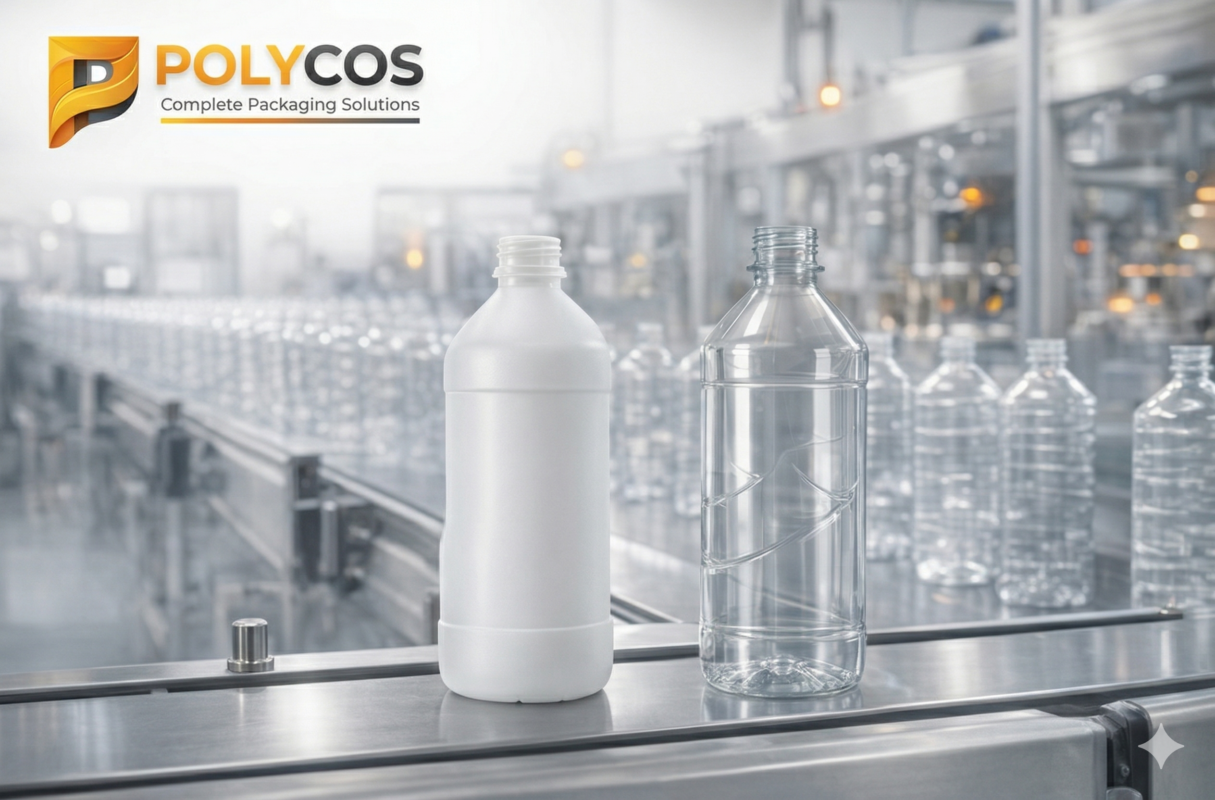
HDPE bottles prevent product leakage more reliably than PET bottles in Middle East logistics. This occurs because HDPE’s flexible walls absorb transport vibration and pressure changes without stressing the cap seal. In contrast, PET bottle rigidity concentrates mechanical stress at the neck thread junction when internal pressure rises or when pallet vibration applies a cyclic load to the cap.
In high-temperature UAE shipping conditions, container temperatures often reach 60°C to 80°C. Consequently, PET neck threads expand at a different rate than most cap liners. This mismatch creates micro-gaps that cause leakage, even when the cap torque specification appears correct.
This article covers five leakage mechanisms and a product-type comparison. Furthermore, we will examine the engineering threshold for switching from PET to HDPE. Poly Cos Industries manufactures PET and HDPE bottles with UAE-specific neck finish tolerances specifically for GCC logistics.
How Bottle Material Affects Leakage During Transport
HDPE and PET create different leakage risks because wall flexibility, neck thread geometry, and cap liner interaction differ between the two materials. While HDPE absorbs mechanical energy in the bottle wall, PET transfers it directly to the cap seal.
Wall Flexibility and Seal Integrity
PET has a flexural modulus of 2.7 to 4.0 GPa, whereas HDPE has a flexural modulus of 0.8 to 1.5 GPa. Essentially, a PET bottle wall is approximately three times more rigid than an HDPE wall of the same thickness. When pressure rises inside a sealed PET bottle during UAE summer shipping, the rigid wall transfers that pressure directly to the neck thread junction and cap liner.
For a practical example, consider a pallet of hot-fill sauce bottles loaded at a Dubai port at 11:00 AM. If the internal container temperature reaches 70°C within 40 minutes, PET bottle walls will transfer the expanding internal pressure to the cap seal continuously for hours. However, HDPE bottle walls in the same load will flex under that pressure, thereby reducing the load on the cap liner contact zone.
Neck Thread Tolerance Under Heat
PET neck threads expand by approximately 70 parts per million per degree Celsius. Meanwhile, most standard polypropylene cap liners expand at 90 to 150 parts per million. Because of this mismatch, micro-gaps often form between the neck finish and cap liner above 50°C.
On the other hand, HDPE neck threads expand at a rate of 150 to 200 parts per million. This range is much more compatible with standard liners. Therefore, HDPE bottles maintain contact pressure under the same heat conditions that cause PET seals to fail.
Why Transport Vibration Causes PET Bottles to Leak More
Transport vibration applies a cyclic mechanical load to the cap seal on main GCC logistics routes. Because of its rigidity, PET transfers this load to the neck thread with each vibration cycle.
Steel shipping containers on a Dubai to Abu Dhabi route experience continuous vibration for the full journey. At an average speed of 50 km/h, a 6-hour route delivers approximately 21,600 vibration cycles to every bottle on a pallet. Each cycle applies a small torque load to the cap. Over time, this cumulative torque loss reduces the cap seal pressure below the minimum required to prevent leaks. Conversely, HDPE walls flex to absorb a portion of each vibration cycle.
Comparison of Leakage Risks by Product
The correct material choice for leakage prevention depends on several factors, such as product viscosity, fill temperature, and internal pressure. HDPE generally prevents leakage better across most high-risk categories.
| Product Type | PET Leakage Risk | HDPE Leakage Risk | Recommended Material |
| Water and Juice (Ambient) | Low | Low | Either |
| Carbonated Beverages | Medium | Low | HDPE or Heat-set PET |
| Hot-fill Sauces and Oils | High | Low | HDPE |
| Chemical Cleaning Products | High | Medium | HDPE (Chemical Liner) |
| Essential Oils | Very High | Medium | HDPE with PTFE Liner |
Specific Risks for Essential Oils and Hot-Fill
Essential oils represent the highest-risk category for PET leakage. This is because high-concentration oils can penetrate PET walls at the molecular level, causing the bottle to swell and increasing internal pressure. However, HDPE with a PTFE liner prevents both permeation and seal failure.
Hot-fill sauces are also a common source of leakage complaints in the UAE. Products filled above 60°C expand PET neck threads immediately upon capping. As the bottle cools, a micro-gap forms and the cap torque partially releases. In contrast, HDPE handles hot-fill applications reliably when paired with a matched induction seal.
When to Use PET for Leak-Sensitive Applications
PET can prevent leakage reliably if the product ships in temperature-controlled vehicles and uses an induction seal. These conditions eliminate the primary leakage mechanisms associated with PET. For instance, water and ambient-temperature juice products show equivalent performance in PET and HDPE when transported in refrigerated vehicles.
Manufacturing Solutions by Poly Cos Industries
Poly Cos manufactures PET and HDPE bottles with UAE-specific neck finish tolerances to prevent these issues. We provide packaging consultations to help companies identify the best material and neck finish combination for their specific logistics routes.
Consider switching from PET to HDPE if:
- Your product fill temperature exceeds 50°C.
- Your transport route involves more than 6 hours of road vibration.
- The product contains solvents or essential oils.
- Shipping containers are not cooled below 40°C during the UAE summer.