Plastic Bottle Manufacturers in UAE – Poly Cos

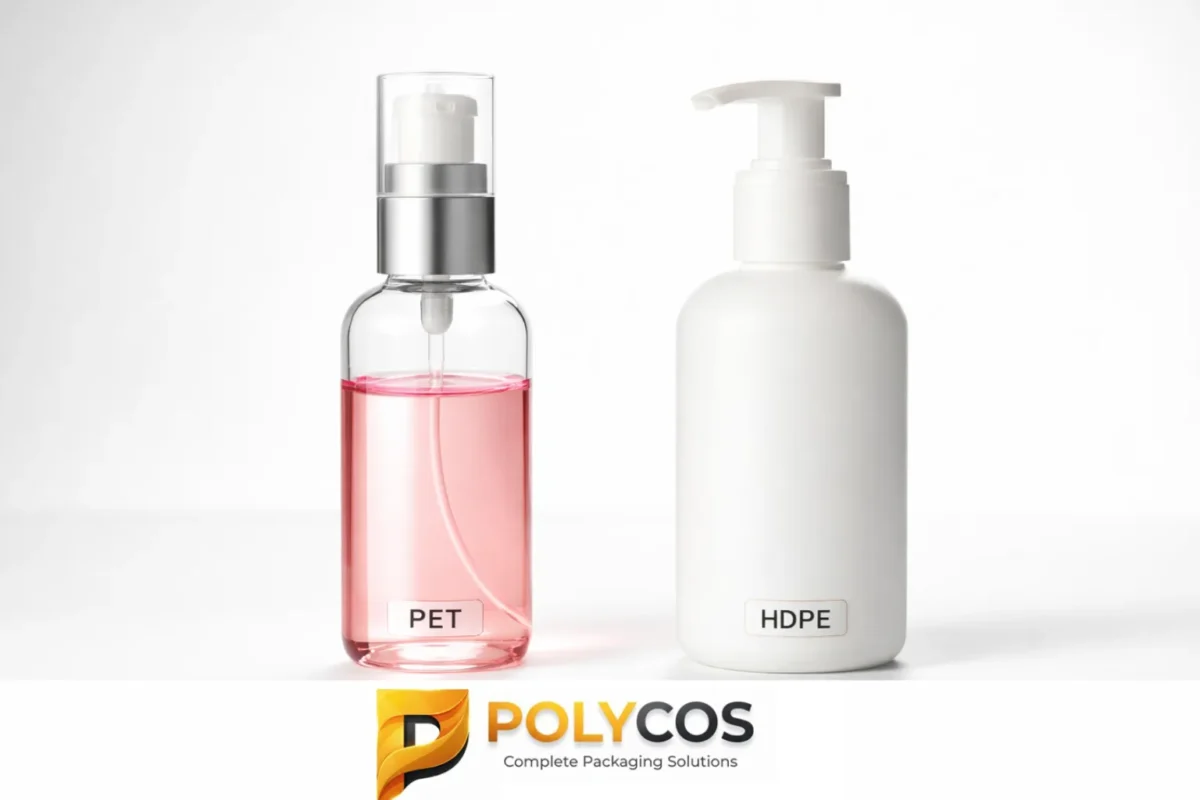
Cosmetic brands prefer PET bottles because PET transmits over 85% of visible light, making product colour and texture visible through the bottle wall. Companies working with a plastic bottle manufacturer in the UAE often choose PET for retail visibility and shelf appeal.
Manufacturers recommend HDPE because HDPE resists essential oils, surfactants, and alcohol-based serums without absorbing or degrading the formula, and handles UAE warehouse temperatures up to 80°C without deformation.
The right choice between PET and HDPE depends on your formula chemistry, distribution environment, and target retail channel.
Every luxury skincare shelf is lined with crystal-clear PET. Every experienced packaging engineer recommends HDPE.
Both are right. For different reasons. This article gives you the exact answer for your product.
What Are PET and HDPE Cosmetic Bottles?
PET (Polyethylene Terephthalate) is crystal clear, lightweight, and widely used in retail cosmetic packaging.
HDPE (High-Density Polyethylene) is opaque or semi-translucent with superior chemical resistance and heat tolerance up to 80°C.
Key differences at a glance:
- PET: >85% light transmittance
- HDPE: resists essential oils, solvents
- PET glass transition: 75°C
- HDPE heat distortion: 80°C under load
- HDPE cheaper above 10,000 units
The choice between PET and HDPE is not about which is better. It is about which is correct for the specific formula and supply chain.
| Property | PET Bottle | HDPE Bottle |
| Clarity | Crystal clear (>85% transmittance) | Opaque / milky |
| Chemical Resistance | Limited — absorbs essential oils, alcohols >40% | Excellent — resists most cosmetic chemicals |
| Heat Tolerance | 75°C glass transition — deforms in UAE summer | Handles 80°C under load |
| Essential Oil Compatibility | Absorbs aromatics — formula degrades in 60–90 days | Compatible — no absorption |
| Hot-Fill Compatible | Requires heat-set PET (HPET) only | Standard HDPE handles 70–75°C |
| Cost (10,000+ units) | Higher per unit | 15–20% lower per unit |
| UAE Logistics (summer) | At risk above 60°C container temp | Safe to 80°C container temp |
| Retail Shelf Perception | Premium / luxury | Professional / functional |
Why Do Cosmetic Brands Choose PET for Retail Packaging?
Cosmetic brands choose PET bottles because PET transmits over 85% of visible light, making product colour and texture visible through the bottle wall driving purchase decisions at retail.
PET wins at the shelf because:
- Clarity: a clear PET serum bottle shows the exact amber colour of the formula. The consumer judges product freshness before opening.
- Label adhesion: PET surfaces accept paper, shrink-sleeve, and direct-print labels without pre-treatment
- Lightweight: PET reduces shipping weight for e-commerce brands. A 100ml PET bottle weighs 18–24g versus 28–36g for equivalent HDPE
- Consumer perception: clear packaging signals premium quality in skincare, serum, and hair care categories
- Low minimum order: PET tooling starts at lower volumes. At under 5,000 units, PET costs 5–10% less per bottle than HDPE
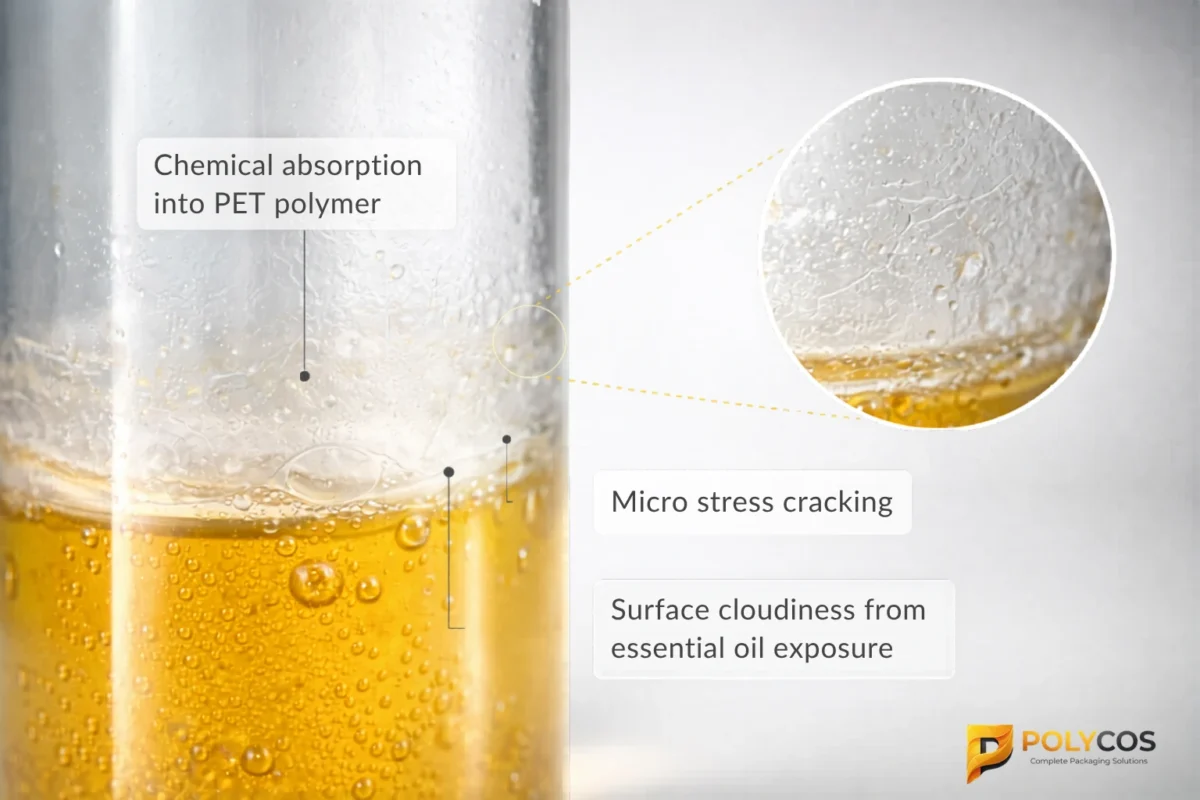
For a startup launching a water-based toner or clear gel, PET makes complete commercial sense.
Why Do Manufacturers Recommend HDPE for Cosmetic Formulas?
Manufacturers recommend HDPE because HDPE does not absorb or react with essential oils, surfactants, or high-alcohol formulas.
PET bottle walls absorb aromatic hydrocarbons within 60–90 days at room temperature — causing cloudiness, concentration loss, and potential batch rejection.
HDPE solves 3 problems PET creates, especially in high-temperature logistics where seal failure becomes common. This is explained in detail in HDPE vs PET bottles for leakage prevention during shipping.
- No essential oil absorption
- Handles 80°C UAE summer heat
- No plasticizer migration into formula
- 15–20% lower cost at scale
At 50,000 units per quarter, choosing HDPE saves AED 8,000–15,000 per production run.
Which Cosmetic Formulas Are Incompatible with PET Bottles?
Three formula types consistently cause failure inside PET bottles. Most brands never trace the problem back to the bottle material.
PET is incompatible with:
- Essential oils above 2% concentration
- Alcohol above 40% — causes stress cracking
- Fragrance concentrates above 5%
HDPE resists all three at standard cosmetic concentrations.
When Should a Cosmetic Brand Choose PET?
Choose PET bottles for cosmetic products that are water-based, alcohol-free, and distributed through temperature-controlled retail or e-commerce channels.
PET is the correct choice when:
- Formula is water-based: micellar water, toner, light lotion, clear gel, aloe vera gel — no essential oils, alcohol below 20%
- Distribution is climate-controlled: premium retail, gifting, e-commerce with foam packaging — no summer open-truck logistics
- Visual product display drives purchase: the consumer sees the formula colour before buying — rose water, coloured serums, gradient creams
- Volume is under 5,000 units: PET tooling economics favour small initial production runs
- Brand positioning is luxury / premium: PET maintains the aesthetic premium that justifies higher retail price points
When Should a Cosmetic Brand Choose HDPE?
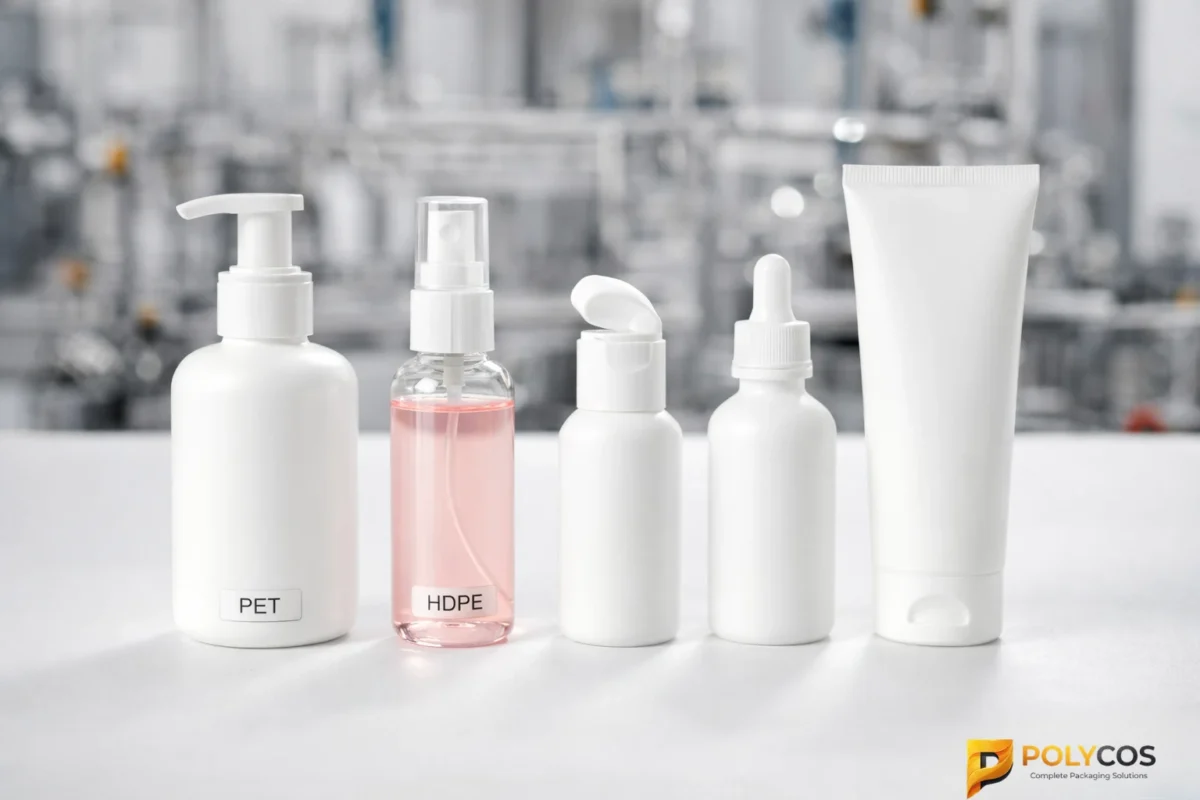
Choose HDPE bottles for cosmetic products containing essential oils, fragrance concentrates, high-alcohol serums, or products shipping through UAE and GCC summer logistics.
HDPE is the correct choice when:
- Formula contains essential oils at any concentration above 2% — tea tree, eucalyptus, bergamot, citrus, lavender
- Formula contains alcohol above 40% — perfume-grade serums, toning mists, hand sanitisers
- Formula is hot-fill above 60°C — certain lotions, conditioners, and industrial-adjacent personal care
- Distribution routes pass through UAE or GCC without temperature control — particularly in June–September
- Production volume exceeds 10,000 units per run — HDPE delivers 15–20% lower per-unit cost at scale
- Brand category is professional, therapeutic, or pharmaceutical-adjacent — where functional credibility outweighs shelf aesthetics
How to Choose Between PET and HDPE: The Decision Table
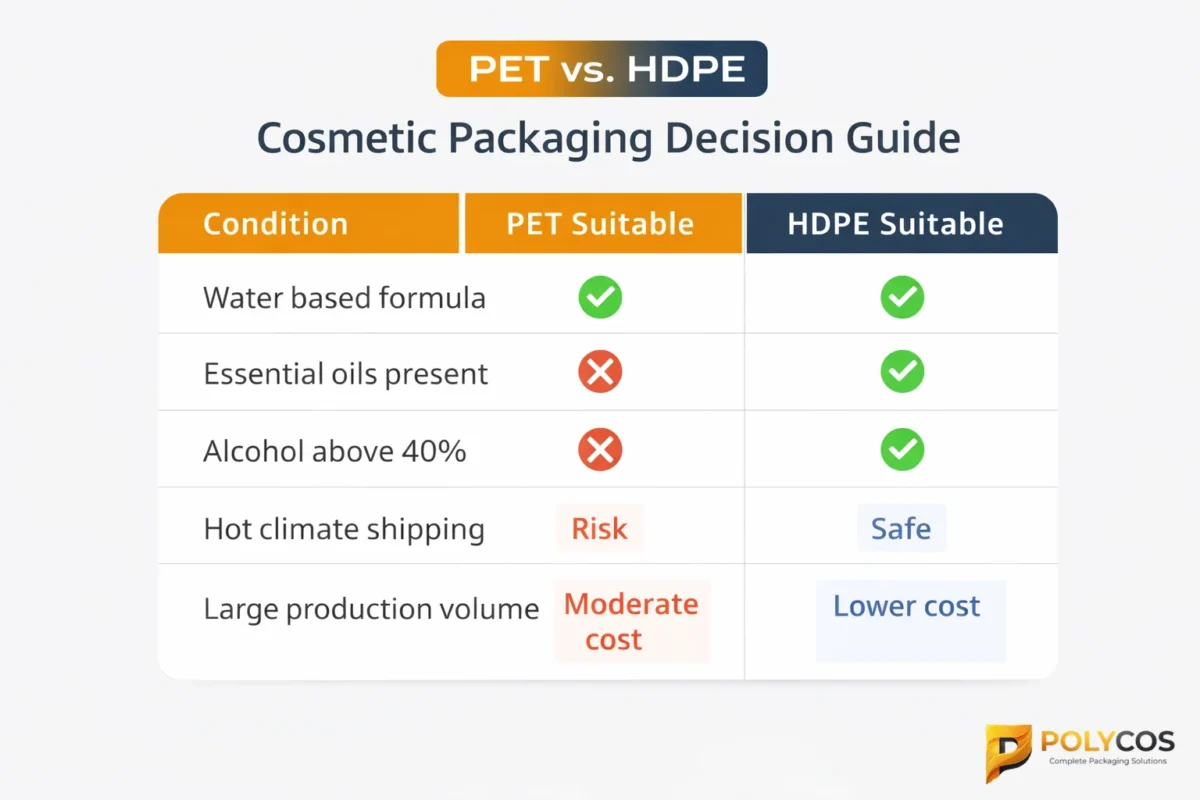
| Your Product Situation | Choose PET | Choose HDPE |
| Formula type | Water-based, no essential oils, alcohol <20% | Essential oils >2%, alcohol >40%, surfactant-heavy |
| Distribution | Climate-controlled, retail, e-commerce | UAE/GCC open truck, summer shipping |
| Volume | Under 5,000 units | Above 10,000 units |
| Fill temperature | Ambient temperature fill | Hot fill above 60°C |
| Shelf life requirement | Under 12 months, stable formula | 18+ months, chemically active formula |
| Brand positioning | Luxury retail, gifting, premium shelf | Professional, therapeutic, industrial-adjacent |
| Storage condition | Indoor climate-controlled warehouse | Outdoor, open warehouse, UAE summer |
Can Polycos Industries supply HDPE bottles that look premium enough for retail cosmetics?
Yes. Polycos Industries manufactures HDPE cosmetic bottles with glossy surface finishes, smooth neck rings for pump and spray compatibility, and labelling surfaces that accept premium paper and shrink-sleeve labels. HDPE cosmetic bottles in natural, white, or custom colours are supplied to cosmetic brands across UAE and GCC. Contact Polycos Industries for sample options.
Choosing the right bottle material starts with your formula not your aesthetic preference. Polycos Industries reviews formula chemistry before recommending PET or HDPE and supplies both to cosmetic brands across UAE and GCC. Contact poly-cos for a free pre-production material review.
Frequently Asked Questions
Can PET bottles be used for essential oil cosmetics?
PET bottles are not recommended for essential oil cosmetic formulas. PET polymer chains absorb aromatic hydrocarbons — the primary chemical family in essential oils — within 60–90 days at room temperature. This causes visible bottle wall cloudiness, formula concentration loss of 10–30%, and potential regulatory non-compliance for cosmetics with standardised active levels.
What is the cost difference between PET and HDPE cosmetic bottles in UAE?
At volumes below 5,000 units, PET bottles cost 5–10% less than HDPE due to lower tooling setup costs. At volumes above 10,000 units, HDPE bottles cost 15–20% less per unit. For a brand producing 50,000 units quarterly, choosing HDPE at the correct volume saves AED 8,000–15,000 per production run.
Does HDPE cosmetic packaging meet UAE cosmetics regulatory requirements?
Food-grade and cosmetic-grade HDPE meets UAE ESMA requirements for cosmetic-contact packaging. HDPE does not leach plasticizers and is approved for contact with cosmetic formulations under UAE cosmetics regulations. Polycos Industries supplies HDPE bottles with material safety data sheets and compliance documentation for ESMA submission.
At what alcohol concentration does PET become incompatible with cosmetic serums?
PET begins showing micro-stress cracking at alcohol concentrations above 40% over 3–6 months of bottle contact. For cosmetic serums with alcohol above 20%, HDPE is the safer long-term specification. For hand sanitisers and perfume-grade products with alcohol above 60%, HDPE is the only appropriate bottle material.