Plastic Bottle Manufacturers in UAE – Poly Cos

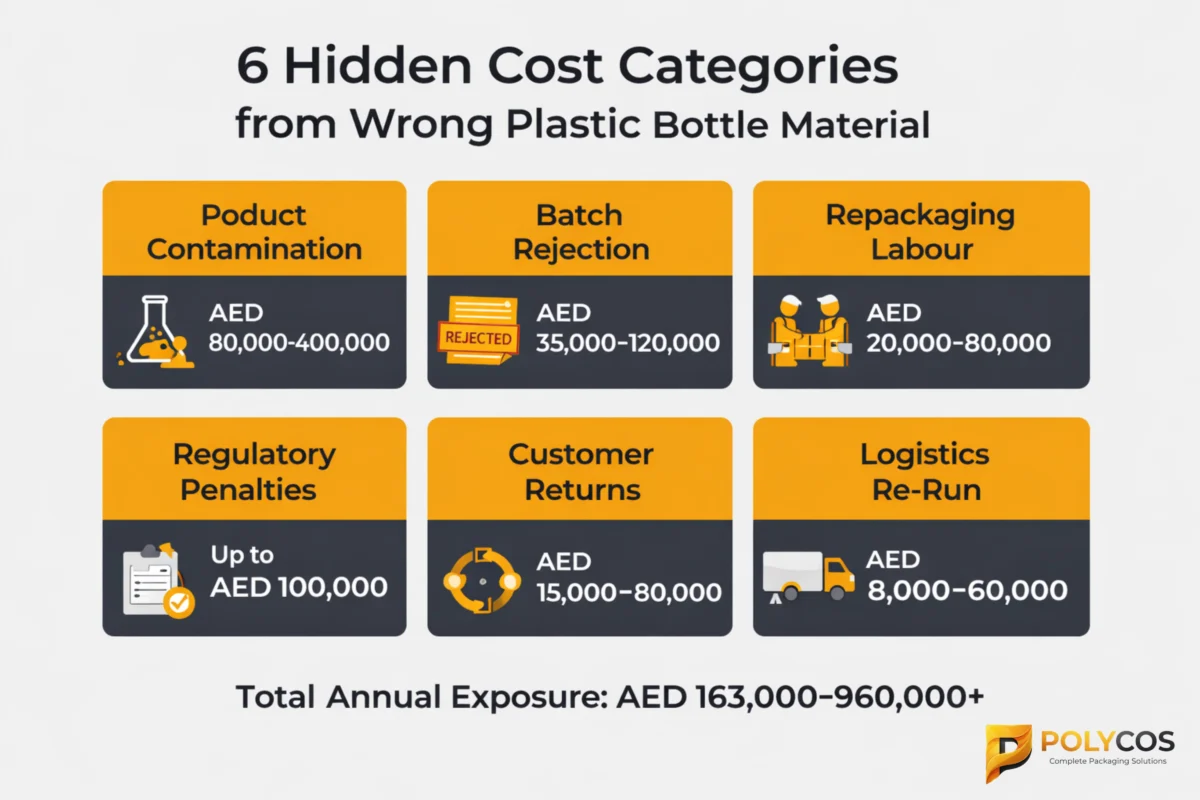
Choosing the wrong plastic bottle material creates 6 hidden cost categories that UAE manufacturers rarely trace to a single source: product contamination, batch rejection, repackaging labour, regulatory penalties, customer returns, and logistics re-runs.
PET bottles used for essential oil formulas absorb aromatic compounds within 60 to 90 days, triggering batch rejection at GCC customs; HDPE containers specified below minimum wall thickness crack under pallet compression when UAE warehouse temperatures exceed 60°C.
For mid-size manufacturers in UAE and GCC, these costs range from AED 163,000 to AED 960,000 per product line annually, and this article maps every category, traces each root cause, and outlines the 5-step audit that prevents all of them.
Why This Cost Never Appears on the Invoice
Wrong plastic bottle material creates 6 hidden cost categories that spread across quality, logistics, regulatory, and customer service departments at the same time. Because each department absorbs only a fragment of the total, no single P&L line ever shows material selection as the cause.
The 6 categories are:
- Product contamination
- Batch rejection
- Repackaging labour and downtime
- Regulatory penalties and customs holds
- Customer returns and platform penalties
- Logistics re-run and emergency freight
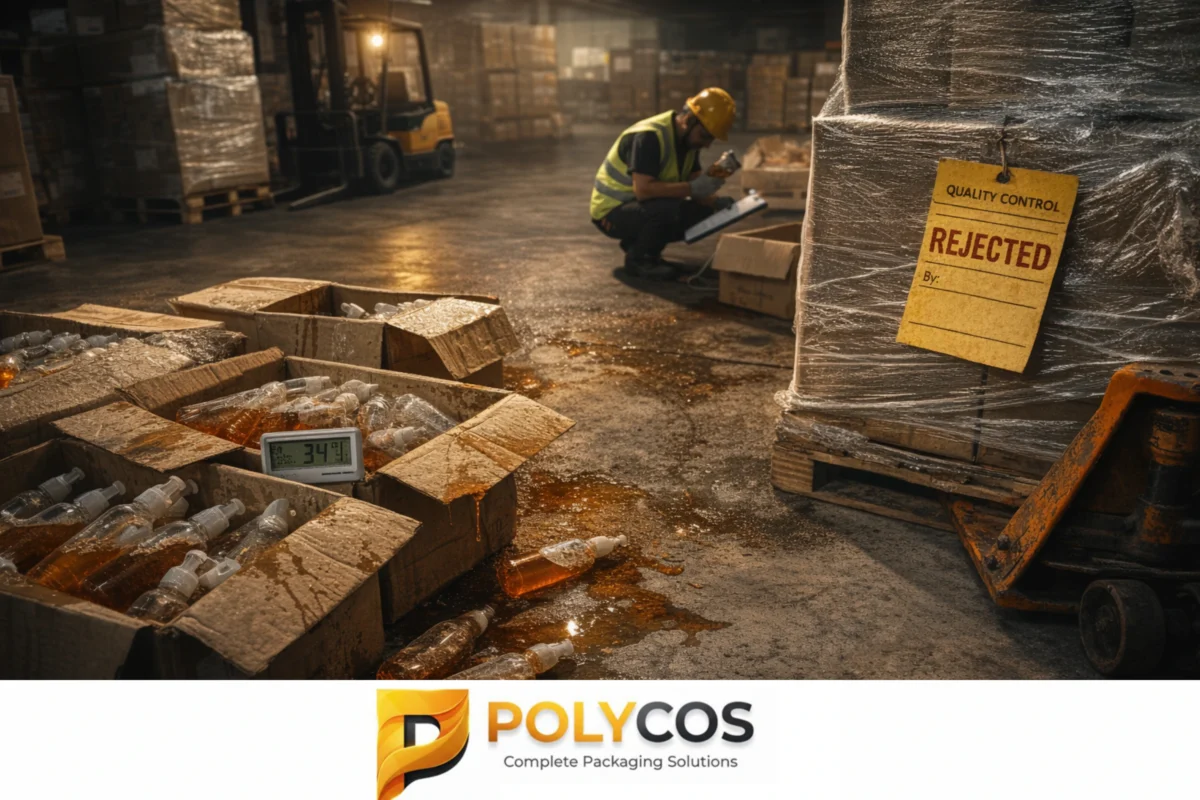
Open a box of 500 body oil serums that shipped in PET bottles through a UAE summer route. The bottles feel slightly tacky at the shoulder. A faint cloudy ring sits just below the fill line — aromatic compounds have migrated into the PET bottle wall during the 72-hour transit at 68°C. The quality manager marks the pallet red. The fill team is already on break. The 200,000-unit batch sits in the rejection zone while the finance team tries to locate which budget line absorbs the AED 340,000 loss.
Procurement managers who study the full PET vs HDPE material breakdown for the first time consistently name the contamination timeline as the detail that surprises them most.
Cost Categories 1 and 2: Contamination and Batch Rejection
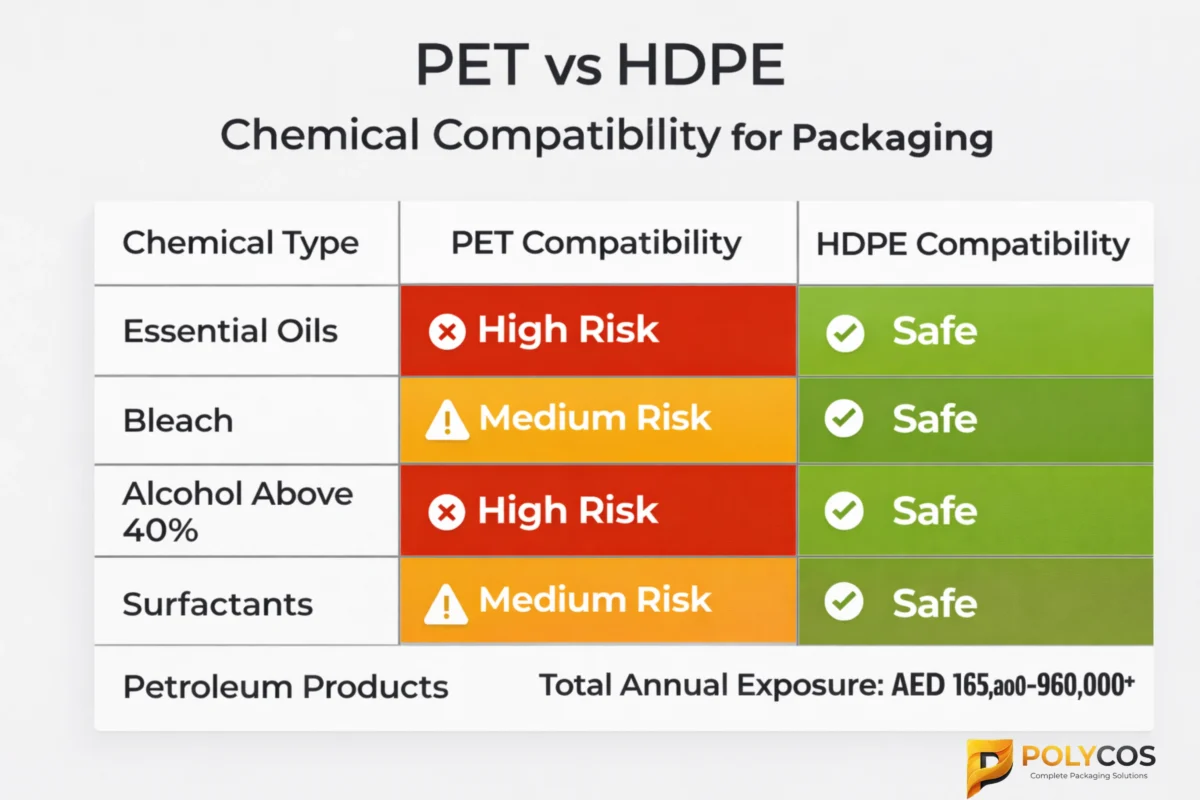
Product contamination in PET bottles happens when the formula contains aromatic hydrocarbons that absorb into the PET polymer wall within 60 to 90 days at room temperature. Absorption changes formula concentration, causes visible cloudiness, and triggers batch rejection at GCC customs or retailer quality inspection.
Contamination triggers in PET bottles include:
- Essential oils absorbed within 60 to 90 days
- Alcohol above 40% causes micro-cracking in walls
- Fragrance concentrates above 5% migrate through walls
What batch rejection actually costs:
- Fill loss per 50,000-unit batch: AED 400,000 to 2,000,000
- Logistics and disposal: additional AED 20,000 to 60,000
- Factory idle time: AED 15,000 to 30,000 per day
- Regulatory hold at customs: 5 to 10 business days
Brands that move to HDPE cosmetic bottle specifications after a contamination event typically find the material change alone resolves the issue without any reformulation of the product.
The same failure pattern appears across beverage, cleaning product, and cosmetic categories in UAE. Procurement managers sourcing plastic packaging for UAE manufacturing who select material by appearance rather than formula chemistry carry the highest exposure to this cost category.
Cost Categories 3 and 4: Repackaging and Regulatory Risk
Repackaging a 50,000-unit batch costs AED 35,000 to 120,000 in labour alone, before factory downtime, emergency bottle procurement, and retailer delivery penalties are counted. Emergency replacement bottle procurement carries a 20 to 35% premium over standard order pricing, and factory line reallocation runs AED 20,000 to 80,000 per 3 to 5 day cycle.
Regulatory exposure from non-compliant packaging includes:
- ESMA fine: up to AED 100,000 per violation
- Customs demurrage: AED 5,000 to 20,000 per stopped shipment
- Shipment hold: 5 to 10 business days minimum
- SASO certification failure: blocks all GCC export clearance
Picture the ESMA inspector at Dubai customs. He holds up a cosmetic serum bottle and checks the packaging compliance certificate. Nothing is attached. The shipment — 18 pallets — stops at the bay for seven business days. The importer pays AED 14,000 in demurrage. A retailer late-delivery penalty follows. The distributor calls to confirm the seasonal window has already closed.
Cost Categories 5 and 6: Returns and Logistics Re-Run
Customer returns from leaking bottles cost 3 to 5 times the original unit sale value once return processing, platform penalties, and retailer chargebacks are included. A 2% return rate on Amazon UAE or Noon triggers an account health penalty that cuts future SKU visibility across all products in the catalogue, not only the failed SKU.
Return cost breakdown per 10,000 leaking units:
- Return processing cost: AED 85 to 150 per unit
- Retailer chargeback: AED 150 to 500 per unit
- Platform account health penalty above 2% return rate
- Distributor next reorder reduction: 30 to 60%
One GCC e-commerce brand received 430 customer return requests in a single week. Bottles had leaked in delivery. Each return cost AED 180 in shipping, inspection, and disposal against an original unit sale of AED 45. The Amazon UAE account flag appeared within hours. Page ranking dropped. The next distributor reorder arrived at 40% of its previous volume.
GCC re-dispatch logistics runs AED 8,000 to 25,000 per truck. Emergency air freight costs AED 15,000 to 60,000 per shipment. Missed retail windows do not get rescheduled.
Brands already familiar with how industrial containers fail in UAE summer conditions will recognise the same root cause here: material specified for the wrong environment.
Total Cost and How to Run a Compatibility Audit
A material compatibility audit takes 1 to 2 weeks before tooling and prevents every cost category listed above. Polycos Industries conducts pre-production reviews that cross-reference formula chemistry against PET and HDPE resistance data before production begins.
Total hidden cost range by category:
| Cost Category | Min (AED) | Max (AED) |
| Batch Rejection | 80,000 | 400,000 |
| Repackaging and Downtime | 35,000 | 120,000 |
| Regulatory and Compliance | 5,000 | 100,000 |
| Customer Returns | 15,000 | 80,000 |
| Brand Reputation Impact | 20,000 | 200,000 |
| Logistics Re-Run | 8,000 | 60,000 |
| Total Annual Range | 163,000 | 960,000+ |
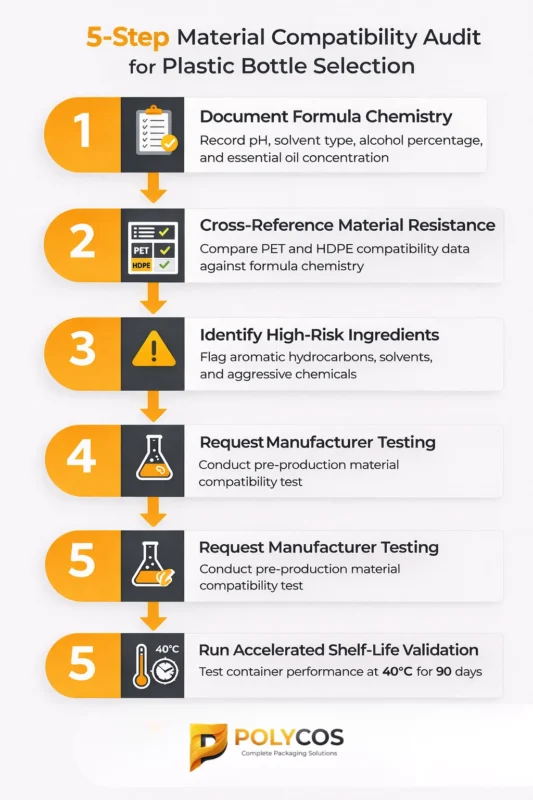
The 5-step audit process:
- Document formula chemistry: pH, solvents, alcohol %, essential oil content by concentration
- Cross-reference PET and HDPE resistance chart against the formula class
- Flag high-risk ingredients: aromatics, chlorinated solvents, high-alcohol concentrations
- Request pre-production testing from Polycos Industries before tooling is committed
- Run accelerated shelf-life test at 40°C for 90 days, check wall integrity and formula stability
One material compatibility review from Polycos Industries takes 1 to 2 weeks and costs a fraction of the AED 163,000 minimum hidden loss range. The Polycos team cross-references your formula against PET and HDPE resistance data before tooling is confirmed. Request a pre-production review at poly-cos plastic-bottle-manufacturer-in-uae before your next production run.
Frequently Asked Questions
What does wrong plastic bottle material cost a UAE manufacturer?
Choosing the wrong plastic bottle material costs UAE manufacturers between AED 163,000 and AED 960,000 per product line annually across 6 hidden cost categories. These costs distribute across quality, logistics, regulatory, and customer service departments, which is why material selection is rarely identified as the root cause without a structured packaging audit.
How does contamination happen in PET bottles?
Contamination in PET bottles happens when formula ingredients containing aromatic hydrocarbons absorb into the PET polymer wall within 60 to 90 days at room temperature. Essential oils, fragrance concentrates above 5%, and alcohol above 40% are the three primary triggers. Absorption causes visible cloudiness and formula concentration loss, both of which trigger rejection at GCC customs or retailer inspection.
What is ESMA’s penalty for non-compliant cosmetic packaging?
ESMA issues compliance fines up to AED 100,000 per violation for cosmetic-contact packaging that lacks material compatibility certification. Shipments stopped at customs also incur demurrage of AED 5,000 to 20,000 per hold, plus retailer late-delivery penalties. Total exposure from a single non-compliant shipment regularly exceeds AED 120,000.
How long does a material compatibility audit take?
A material compatibility audit takes 1 to 2 weeks when conducted before the tooling decision. The process covers formula documentation, resistance cross-referencing, risk identification, manufacturer testing, and a 90-day accelerated shelf-life test at 40°C. That timeline is a fraction of the 3 to 5 months typically lost to a batch rejection and repackaging cycle.
Does Polycos Industries offer pre-production material reviews?
Polycos Industries conducts pre-production material compatibility reviews for brands sourcing PET and HDPE bottles in UAE and GCC. The review cross-references formula chemistry against material resistance data, identifies risk ingredients, and recommends the correct bottle material and wall specification before production begins. Brands can request a review at poly-cos.com/contact-us-plastic-bottle-manufacturer-in-uae.
What is the most common trigger for PET bottle contamination in UAE?
Essential oils cause the majority of PET bottle contamination cases in UAE cosmetic manufacturing. PET polymer chains absorb aromatic hydrocarbons — the primary chemical family in tea tree, lavender, eucalyptus, and citrus oils — within 60 days at room temperature. Any cosmetic formula containing essential oils above 2% concentration requires HDPE, not PET.