Plastic Bottle Manufacturers in UAE – Poly Cos
LEADING PLASTIC MANUFACTURER IN UAE
- Sun - Fri: 9AM - 6PM
- India | UAE | Oman | China
- 0526029353
- India | UAE | Oman

Why PET Bottles Crack During Shipping in Hot Middle East Climate
Why PET Bottles Crack During Shipping in Hot Middle East Climate
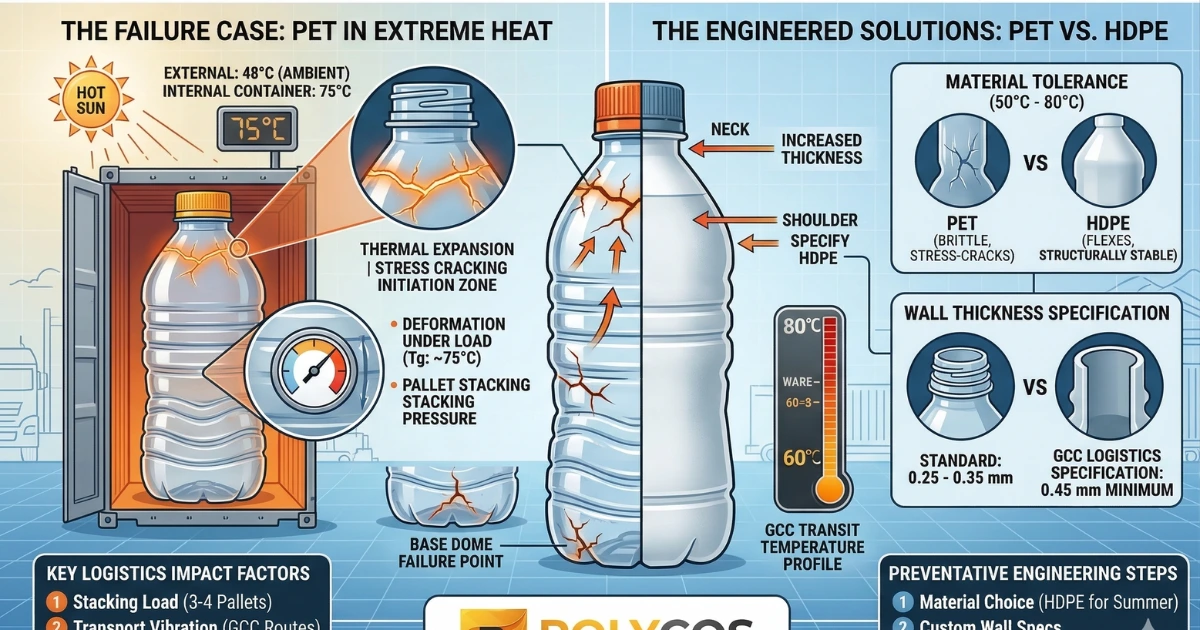
PET bottles crack during shipping in hot Middle East climates because extreme transport temperatures weaken polymer strength. Internal pressure inside sealed bottles increases at the same time.
When shipping containers reach 50–60°C, PET begins to experience thermal expansion and stress concentration around the bottle neck and sidewalls.
Pallet stacking pressure and transport vibration make the problem worse.
These conditions can lead to stress cracking, deformation, or complete bottle failure before the product reaches customers.
This article covers the four main failure causes, how to identify damage, and which engineering decisions prevent recurrence. Poly Cos Industries manufactures PET and HDPE bottles for industrial logistics across the UAE and GCC.
What Are PET Bottles Used For?
PET bottles are widely used for packaging beverages, cosmetics, chemicals, and pharmaceutical liquids.
Their lightweight structure, clarity, and durability make them one of the most widely used packaging materials in global supply chains.
However, when products are transported through hot logistics environments such as the Middle East, PET material can become vulnerable to heat-related stress.
Understanding how these conditions affect PET packaging helps manufacturers design bottles that can withstand regional shipping conditions.
Why PET Bottles Crack During Shipping
PET bottles crack during Middle East shipping when heat, pressure, and mechanical stress occur at the same time.
Four conditions usually combine to create failure:
- Polymer softening from heat
- Internal pressure inside sealed bottles
- Thin wall stress concentration
- Transport vibration during logistics
Each factor increases stress on the bottle.
When they occur together, cracking becomes likely.
Another major cause is Environmental Stress Cracking (ESC).
ESC happens when mechanical stress combines with environmental conditions such as heat or chemical exposure.
Common triggers include:
- High container temperatures
- Stacking pressure on pallets
- Cleaning residues or alkaline lubricants
- Long transport vibration during shipping
Under Middle East logistics conditions, these factors accelerate crack formation and allow small fractures to spread across the bottle wall.
Thermal Expansion of PET
PET (polyethylene terephthalate) has a glass transition temperature of about 75°C.
When bottle temperature approaches this level:
- Polymer chains become more mobile
- Bottle walls soften
- Structural stability decreases
This makes the bottle more vulnerable to stress.
Typical failure zones include:
- Shoulder junction
- Neck thread area
- Base corner radius
- Injection gate area
The injection gate area is often the first crack origin.
This part of the bottle contains less molecular orientation than the sidewalls.
Standard PET shoulder walls measure 0.25 to 0.35 mm. UAE logistics requires a minimum of 0.45 mm. This issue compounds the PET Bottle Brittleness Problem: Why Bottles Shatter During Logistics.
Internal Pressure Build-Up Inside Bottles
Sealed bottles trap air and liquid at fill temperature. When container temperatures rise to 50 to 80 degrees Celsius during transit, trapped contents expand. This creates outward pressure against an already heat-weakened wall.
Pressure failure points by location:
• Base dome: first to deform outward under pressure
• Sidewall panels: collapse inward when external stacking load meets internal pressure
• Cap seal: lifts or fails when pressure builds past the seal specification
Hot-fill, carbonated, and chemically active products generate additional pressure beyond ambient expansion. Stress cracking after filling in PET bottles follows this same pressure mechanism.
Bottle Wall Thickness and Structural Weakness
Wall thickness varies across a blow-molded PET bottle.
Some areas are naturally thinner and therefore weaker under heat and pressure.
Typical thickness ranges:
- Standard PET shoulder wall: 0.25–0.35 mm
- Recommended GCC logistics specification: 0.45 mm minimum
Increasing wall thickness improves resistance to:
- thermal expansion
- pallet stacking pressure
- transport vibration
Another important material property is Intrinsic Viscosity (IV).
Intrinsic viscosity reflects the molecular weight of PET resin.
PET resin with lower IV produces weaker bottle walls, making bottles more prone to deformation and stress cracking during high-temperature shipping.
.
Logistics Conditions That Make the Problem Worse
UAE and GCC shipping container interiors reach 60–80°C in summer under direct sun.
Steel shipping containers parked under direct Gulf sun can reach these temperatures quickly, turning palletized bottles into a high-pressure environment during transport.
Engineers designing packaging for GCC distribution must account for container conditions, not warehouse storage conditions.
| Condition | Temperature |
| UAE summer ambient air | 45 to 50 degrees Celsius |
| Uncooled truck cargo area | 55 to 65 degrees Celsius |
| Steel container, direct sun | 60 to 80 degrees Celsius |
| PET glass transition temperature (Tg) | Approximately 75 degrees Celsius |
| PET deformation zone under load | Above 70 degrees Celsius |
Compounding logistics factors:
• Loading and unloading delays: 1 to 4 hours in open sun during port handling
• Stacking pressure: 3 to 4 pallet layers add 15 to 30 kg compressive load on bottom bottles
• Transport vibration: road surfaces on GCC routes widen micro-fractures over 6 to 18 hours
Why Manufacturers Sometimes Choose HDPE Instead
HDPE (high-density polyethylene) resists stress cracking under the temperature ranges common in Middle East container logistics. HDPE walls flex under thermal expansion and recover without fracturing, unlike PET which becomes brittle and cracks.
| Property | PET | HDPE |
| Heat tolerance | Low. Softens above 75°C | High. Stable above 80°C |
| Container resistance | Poor for 60 to 80°C holds | Suitable for hot-climate logistics |
| Wall behavior under heat | Brittle, stress-cracks | Flexes without fracture |
| Hot-fill suitability | Only heat-set PET (HPET) | Standard HDPE handles hot-fill |
| Clarity | Transparent | Opaque to semi-translucent |
| GCC summer logistics | Ambient temperature only | Recommended for summer routes |
For a detailed material comparison, see HDPE bottle performance under UAE logistics heat. For application guidance, read When to Choose HDPE Instead of PET for Industrial Containers.
How to Prevent PET Bottle Cracking in Hot Climate Shipping
Preventing PET bottle cracking in Middle East logistics requires addressing material specification, bottle design, filling conditions, and transport packaging simultaneously. Fixing one variable alone rarely eliminates the failure.
Engineering fixes by failure cause:
1. Increase shoulder and base corner wall thickness to 0.45 mm minimum for UAE summer routes
2. Specify heat-set PET (HPET) for any product with fill temperature above 60 degrees Celsius
3. Add UV stabiliser additives to the resin compound for products with outdoor loading exposure
4. Use insulated pallet covers or foil shrink wrap during open-sun loading and unloading
5. Review fill temperature and nitrogen dosing to minimise internal pressure at cap seal
6. Book ventilated or refrigerated containers for temperature-sensitive PET products
Warning signs that current bottles need re-specification:
• White stress marks on shoulder or base of bottles on warehouse receipt
• Oval or collapsed base profiles after summer storage
• Customer complaints about bottle leakage or deformation on delivery
• Label detachment caused by surface expansion during summer months
Manufacturing Solutions to Prevent PET Cracking
Poly Cos Industries manufactures PET and HDPE bottles with UAE-specific wall thickness specifications. Poly Cos provides packaging consultation for companies shipping across GCC logistics routes in summer conditions.
Poly Cos manufacturing capabilities for hot-climate logistics:
• HDPE bottle manufacturer in UAE: HDPE bottles specified for UAE container temperature exposure
• PET bottle manufacturer and supplier in UAE: standard and heat-set PET (HPET) for hot-fill and ambient applications
• Custom wall thickness specification by bottle zone for GCC summer shipping
• Packaging consultation: material selection based on logistics route, product fill temperature, and stacking conditions
Key Takeaway for Manufacturers
- PET bottles crack during Middle East shipping mainly because container temperatures approach the PET glass transition temperature.
- When heat combines with internal pressure, pallet stacking load, and transport vibration, bottle failure becomes likely.
- Correct material selection, wall thickness, and logistics planning can prevent most shipping damage.
Poly Cos Packaging Solutions for Middle East Logistics
Companies shipping products across the UAE and GCC during summer months need bottle specifications matched to regional logistics conditions.
Poly Cos supplies PET and HDPE bottles to manufacturing, FMCG, and chemical companies across the Middle East. Poly Cos plastic packaging specialists review logistics conditions, fill specifications, and current bottle designs to recommend the right material and wall specification for each route.
Contact the Poly Cos team to request a packaging consultation for your UAE or GCC distribution.